
Two Delaware Projected Release Systems
Delaware County Jail and the Ohio Department of Rehabilitation and Correction use different labels. The sheriff's current detail calls its prospective field Scheduled Release. ODRC calls its field Expected Release Date/Parole Eligibility Date. Both describe a future milestone based on information then in the record. Neither is a completed-release field.
The distinction follows the custody episode. A person serving a county jail sentence is tracked through the Delaware County court judgment and jail record. A person sentenced to state prison is tracked through the Common Pleas judgment and ODRC sentence record. Someone held before trial may have no set date because bond, court orders, unresolved holds, and paperwork control the timing. An ordinary Delaware County bond release does not create an ODRC projected date.
Delaware County also uses two court systems. Municipal Court supplies misdemeanor sentences, bond decisions, dismissals, and preliminary felony entries. Common Pleas supplies felony judgments, stated prison terms, jail-time credit, commitments to ODRC, and later judicial-release or sentence-modification entries. The docket explains the legal source of a date, while the jail or ODRC record shows how the custodian applied it. If a docket date and custody field differ, compare case numbers and ask the responsible office to explain the existing calculation rather than selecting the earlier date.
Find a Delaware Projected Release Date
Begin with the judgment and the current custodian. This prevents a county-jail field from being confused with a state-prison calculation. Keep the full name, date of birth, booking or ODRC number, and court case number when available.
- Check the Delaware County current inmate list for a county booking. Open the detail and treat Scheduled Release only as a prospective field.
- Search Municipal Court for a misdemeanor sentence, bond, dismissal, or preliminary felony matter. Search Common Pleas e-services for a felony judgment, sentence, jail-time credit, commitment, or later modification.
- For state prison, open the ODRC Offender Search. Use the ODRC number when known, or match name, date of birth, Delaware as committing county, docket, judge, and offense.
- Read the exact ODRC label and surrounding sentence details. A parole-eligibility date is a review milestone, not a promised exit date.
- Contact the responsible jail, court, or ODRC records office when credits, holds, or sentence structure make the public result unclear.
- After the projected date, verify actual release through status, Parole or Release Detail, VINE, and the completed release or movement record.
The broader Delaware County release search helps classify county, state, federal, and immigration custody before the calculation begins.
Note: A pretrial detainee may have no fixed release date because no final sentence has yet supplied a term to calculate.
Delaware Jail Scheduled Release Field
The sheriff's official roster code exposes Scheduled Release inside a current inmate detail. It also defines identity, physical description, arresting agency and date, booking date, cases, charges, address, and a booking image. The public code defines no completed release date, completed reason, or destination. Scheduled Release is therefore a planning field within a current booking, not evidence that the booking ended.
A county sentence calculation begins with the court judgment. The jail may also account for jail-time credit, a lawful work-credit award, a later court order, and any hold. For a pretrial case, bond and discharge paperwork govern rather than a fixed sentence end. Delaware Jail states that officers cannot release a person on a warrant to discharge until proper paperwork reaches the jail, so even an authorizing court entry may precede physical departure.
The official Delaware roster code shows the prospective field among current-detail labels.
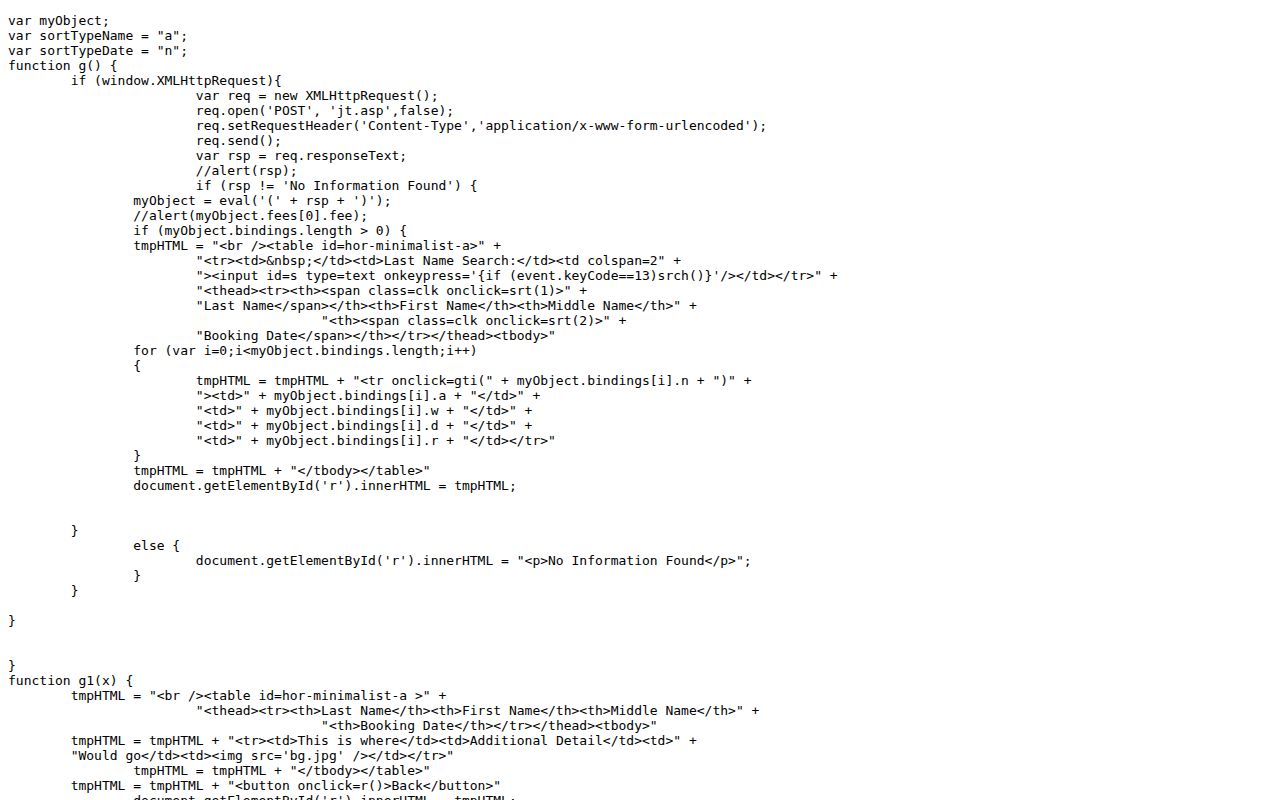
The field inventory supports a narrow conclusion: Scheduled Release can guide a current check, but the completed jail record is needed for the actual date and disposition.
ODRC Delaware Expected Release Date
ODRC's combined label is Expected Release Date/Parole Eligibility Date. ODRC defines it as either a projected release date or a date pending parole consideration. Those meanings must not be collapsed. A projected date reflects sentence calculation; a parole-eligibility date marks when a covered person may be considered under the applicable sentence.
Other ODRC milestones have separate meanings. POA Date is the earliest date a person will be released onto Adult Parole Authority supervision. PRD means Projected Release Date. Earliest Possible Transfer Date concerns transitional control. TC/TT Sentence Expiration can concern projected exit from a halfway-house placement. None alone proves completed release.
Read the ODRC field definitions with the result, as shown below.
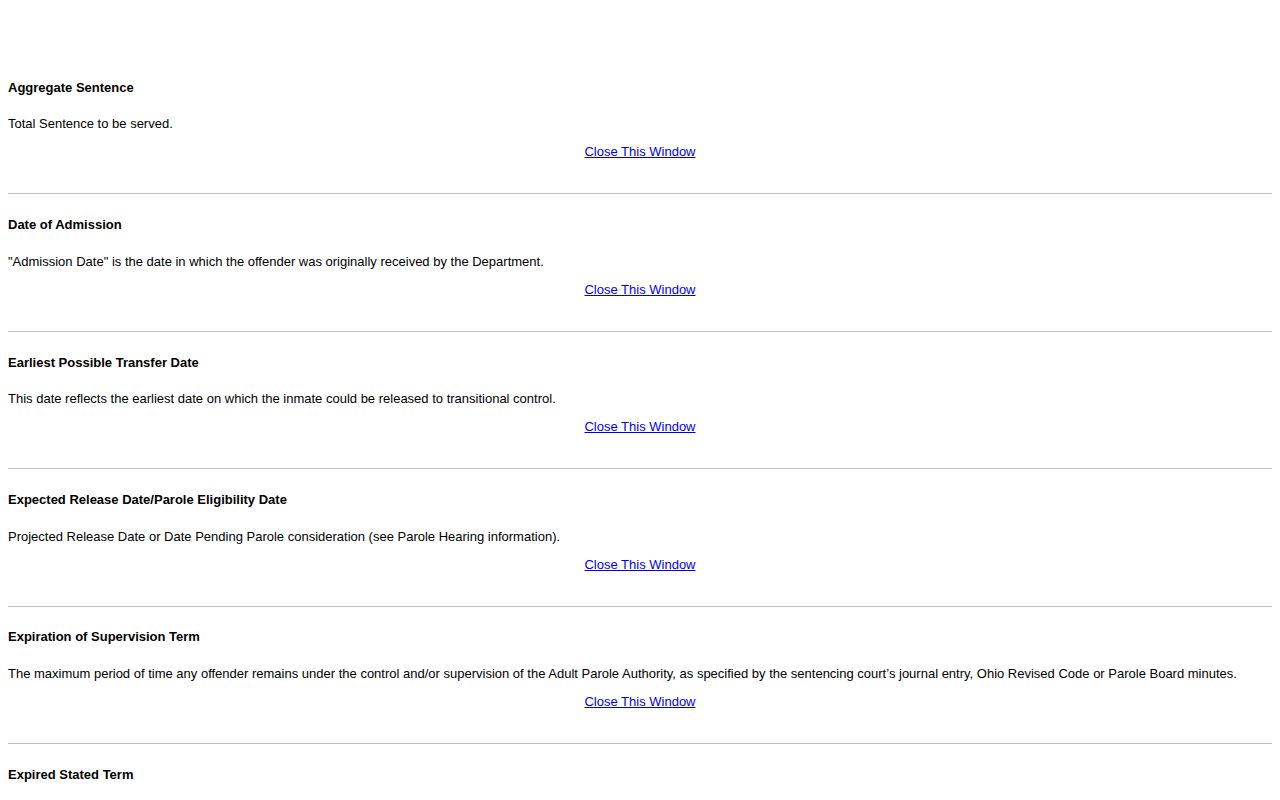
The definitions help distinguish a forecast or review date from Parole or Release Detail, which may appear after release or parole. Actual Status, release detail, and any Supervision Start Date form a stronger online confirmation.
Ohio Earned Credit for Delaware Sentences
Current ORC 2967.194 applies to qualifying confinement on or after April 4, 2024. Eligible people may earn one or five days for each completed month of productive participation in specified programs. Successful completion of a second program may add up to five more days. A separate qualifying completion credit may equal 90 days or ten percent of the stated prison term, whichever is less.
The aggregate cap for ordinary participation and completion credit is 15 percent of the stated term. That cap produces the familiar “serve 85 percent” shorthand. It is not a universal guarantee and should not be used as a simple release-date formula. Credits are provisional and can be denied or withdrawn. Statutory exclusions include nonreducible terms, death, aggravated murder or murder and related forms, life without parole, certain ORC 2971.03 terms, and specified sexually oriented offenses. Reagan Tokes indefinite terms have their own application rules.
Qualifying jail confinement credited against a later prison term is addressed by ORC 2967.191. The judgment's jail-time-credit figure and a later correction can move the ODRC calculation. Older confinement may fall under former law, so a legacy percentage should not be presented as the current rule.
Note: The 15 percent ceiling describes potential qualifying credit, not an automatic reduction for every Ohio prison sentence.
Delaware County Jail Work Credit
County jail work credit follows a different statute. ORC 2947.151 allows the sheriff to award a sentence reduction for work, but only with written concurrence from the presiding or sentencing judge or magistrate. The statute permits the award; it does not require one.
| County jail sentence | Maximum work reduction rate |
|---|---|
| 90 days or less | Up to three days for each 30 days of sentence |
| More than 90 days through six months | Up to four days for each 30 days of sentence |
| More than six months | Up to five days for each 30 days of sentence |
This county framework should never be mixed with ODRC's 15 percent earned-credit cap. One applies to a local jail sentence through a discretionary award and written concurrence. The other applies to qualifying state confinement and program participation under its own rules. Ask the Delaware court and jail records unit how a specific county date was calculated.
Why Delaware Release Dates Change
A projected date can move before release because the inputs or the person's legal status change. Some events reduce time; others delay release or redirect the person into another custody setting. The exact effect must come from the court or custodian, not an assumed rule.
| Factor | Possible effect | Where to confirm |
|---|---|---|
| Corrected jail-time credit | Changes time credited against the prison term. | Court judgment and ODRC sentence detail |
| Earned credit award or withdrawal | May advance or move back a qualifying state projection. | ODRC calculation and records |
| Discipline | May cause provisional credit to be denied or withdrawn. | Custodian record |
| New hold, detainer, or case | May prevent community release or cause transfer. | Court docket and receiving agency |
| Sentence modification or judicial release | Changes the controlling court authority or supervision path. | Common Pleas journal and ODRC status |
| Parole decision | May approve, defer, deny, or later rescind a release path. | Board result, ODRC detail, and official minutes |
| Transitional control or paperwork | Can change the movement milestone or actual departure time. | ODRC or jail movement record |
A detainer is a request or notice that another authority may take custody. It means the end of one sentence does not necessarily produce community release. Likewise, a favorable parole result may precede conditions and administrative steps. Read the actual status and destination after the date arrives.
No Delaware Weekend Release Mandate
No statewide Ohio statute was verified that requires a Friday release whenever a sentence expires on a weekend or holiday. Delaware County also publishes no local policy stating such a rule. A generic claim that every weekend date moves to Friday would therefore be unsupported.
Ask the jail or court how the specific date was calculated and whether a hold or paperwork issue affects movement. For ODRC, read the displayed milestone and contact Central Records when the result is unclear. Calendar assumptions cannot replace the record because county sentences, state terms, parole decisions, and transfers follow different processes.
Note: Do not shift a displayed date to Friday without a specific court, jail, or ODRC record supporting that calculation.
Confirm a Delaware Actual Release
After the projected date, check whether the person still appears in current custody. For a county booking, use the sheriff list, the court docket, and the completed jail release entry. For state prison, read ODRC Status together with Parole or Release Detail and supervision dates. Released and APA Supervision indicate different forms of post-prison status, while an incarcerated result means the person remains in state custody.
Ohio VINE can provide a custody-change notification, but it is not a certified calculation. Register while the person is shown in custody and interpret General Release separately from Transfer. The Delaware VINELink check explains the one-person alert process and acknowledgment steps.
If ODRC data remains unclear, write ODRC Central Records at P.O. Box 430, Columbus, OH 43216. Include the ODRC number and docket and ask for existing movement or release records, release type, discharge or supervision dates, sentence computation, and jail credit. For a county sentence, contact Delaware County Corrections at 740-833-2840 or the relevant court and records office.
A status of APA Supervision means state incarceration has ended but Adult Parole Authority control continues. Judicial Release means the sentencing court authorized release from the state term to community supervision. Neither status describes a routine county-jail bond release. Match the final status with the Delaware County judgment and any supervision start date before treating the projected milestone as completed.
- Projected date
- A calculated future date that may change before custody ends.
- Parole eligibility
- A date for possible release consideration under a covered sentence, not a promised exit.
- Actual release
- The completed custodial movement recorded by the jail or ODRC.
- Supervision
- Control in the community after incarceration, which may continue even though prison custody ended.